Custom and Semi-Custom Cabinetry
in Port Orchard, WA
What Our Customers Say
★★★★★
"We first came across Straight Grain Woodworking online when we were looking for a residential general contractor to manage our kitchen remodeling project. This company had positive reviews about their fine finish carpentry, back splashes and tile flooring abilities which is exactly what we were looking for. They did such a great job for us that we continued to call them out for all of our home renovation and improvement needs. In the last year or so they have installed some custom closet systems, laundry and garage storage cabinets and some custom handrails, mantels and wood trim packages. They always do an amazing job, Doug is very detail oriented and goes out of his way to ensure you are happy with everything."
Gregory Pederson, Google Review
★★★★★
"Working with Straight Up Remodeling was a great experience. They did a beautiful job in a timely manner and were very communicative. We would definitely work with them again!"
Cynthia Griffey, Google Review
This is the conversation we have on almost every job, so it is worth putting the reasoning in writing.
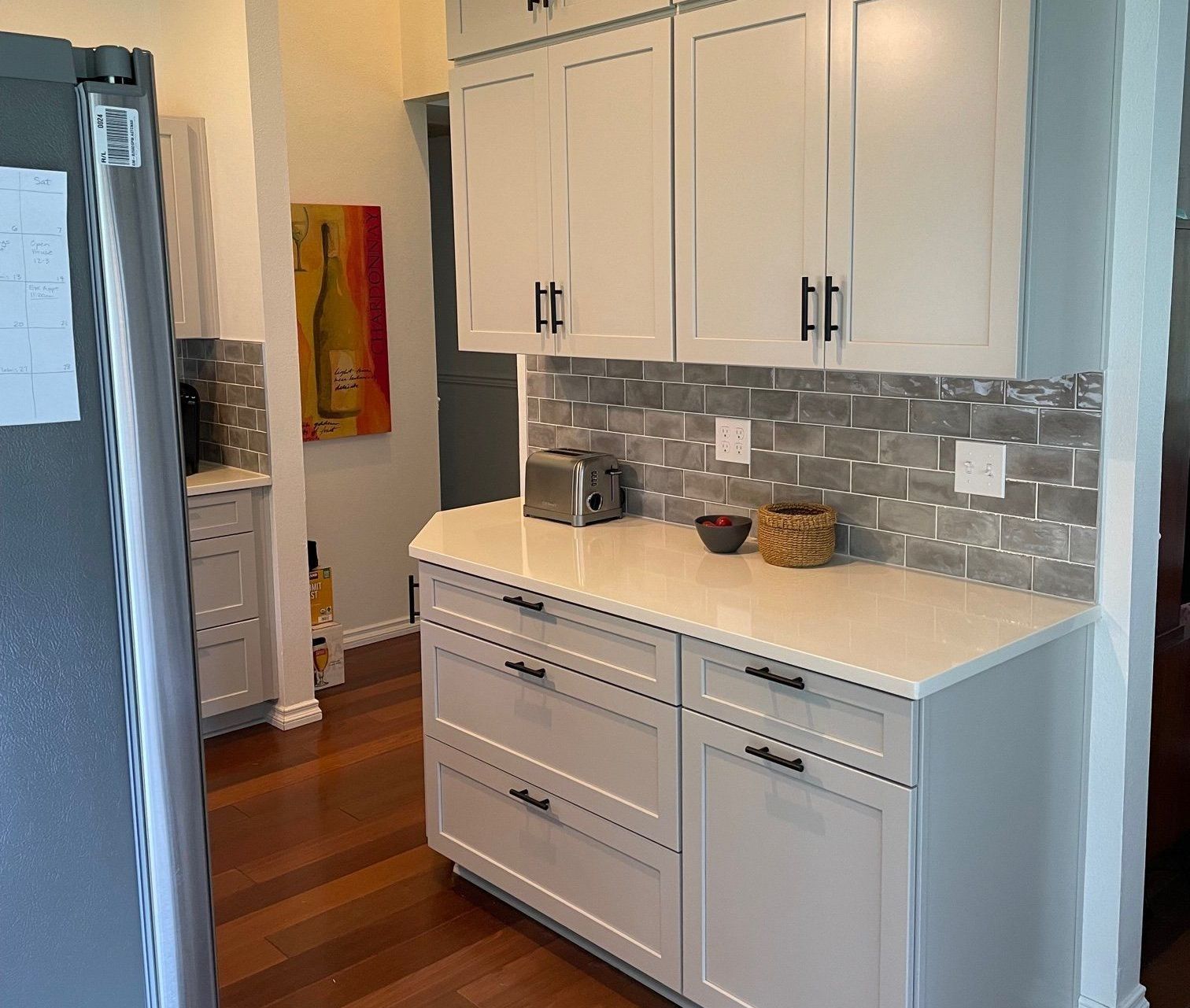
Semi-custom ordering makes sense when the room is a normal shape and the sizes work out. Manufactured lines come in a wide range of widths, styles and finishes, they arrive faster than anything built from scratch, and you are paying a factory to do repetitive work efficiently. For most kitchens, most of the run is semi-custom and that is the right call.
Building in house makes sense
when the room fights back. An odd corner. A ceiling that is not level. A gap between the end of the run and the wall that no stock width fills. An old house where the window sits three inches off center and always has.
Ever seen a kitchen with a strip of filler panel four inches wide next to the fridge?
That is what happens when the only tool available is a catalog. We would rather build that one piece to fit than ask you to live with a filler.
Our honest view: mixing the two is usually the best value on the table. You get factory pricing across the bulk of the kitchen and a built piece exactly where the room needs one. Very few companies around here can offer both, and it is the main reason people call us back for the next room.
Why Semi-Custom Cabinets Work for Most Homes
Semi-custom sits between stock and fully custom, and it is where most of our clients land.
Stock cabinets come in fixed sizes and a short list of doors. Fully custom means every box is made for your room, which is beautiful and slow and expensive. Semi-custom gives you a wide catalog of sizes, door styles, finishes and materials without the wait or the price of building everything from zero.
What you actually get out of it:
- Real cost control. You get the look of a custom kitchen without paying custom prices across every linear foot.
- Faster delivery.
Semi-custom lines ship in a fraction of the time a fully custom order takes, which keeps the rest of your remodel on schedule.
- A fit that suits how you cook. Sizes and interior options are chosen around your habits, not around what happened to be in stock.
- Materials that hold up.
We specify quality boxes and doors, because the cheap ones announce themselves within two years at the hinges.
If you are weighing door styles, we wrote up the trade-offs in
how to choose semi-custom kitchen cabinets: white shaker, slab or inset.
Styles, Finishes and Hardware
The catalog is deep, which is either freeing or paralyzing depending on the day. We narrow it with you.
Styles.
Modern, traditional, rustic and transitional. Shaker still dominates around here, and for good reason, but flat slab doors have been showing up in more Kitsap kitchens over the last few years.
Finishes.
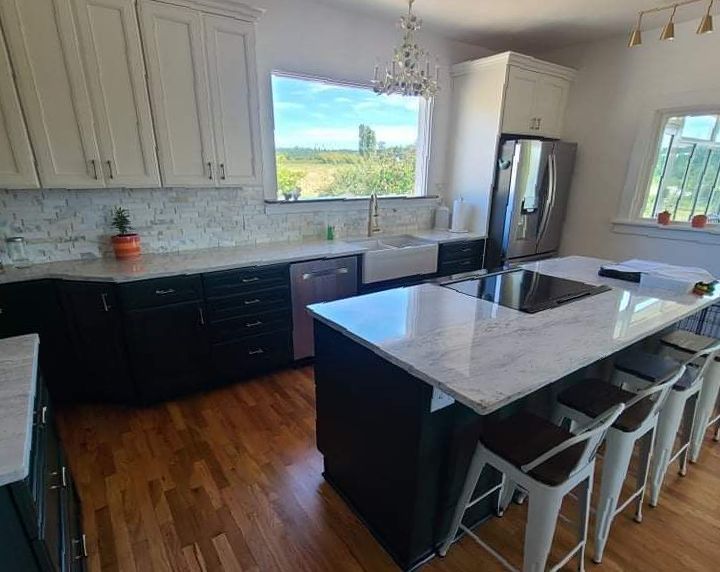
Painted, stained, natural wood or distressed. One local note worth knowing: very dark painted finishes show dust and water spots more in a bright waterfront kitchen than they do in a showroom under even light. Ask to see a sample in your own room before you commit.
Hardware.
Handles, knobs and hinges in a range of finishes. Hardware is the cheapest thing on the whole order and the thing your hand touches twenty times a day, so it is a strange place to economize.
A cabinet is a box. What goes inside the box is what changes your morning.
When was the last time you enjoyed reaching into the back of a base cabinet?
- Pull-out shelves so the back of a deep base cabinet stops being a place things go to disappear
- Soft-close drawers and doors, which we now specify by default rather than as an upgrade
- Lazy Susans and corner solutions, covered in more depth in our piece on maximizing kitchen cabinet corners during a remodel
- Custom dividers for trays, lids, spices and the drawer everyone is embarrassed about
- Trash and recycling pull-outs,
which are worth more than most decorative upgrades
Here is where we would spend the money if the budget is tight: interior function first, decorative detail second. Nobody has ever thanked us for corbels. Plenty of people have thanked us for the pull-out beside the range.
Cabinetry Beyond the Kitchen
Cabinets are the largest single line item in most kitchens, so that is where the attention goes. But the same work applies through the house.
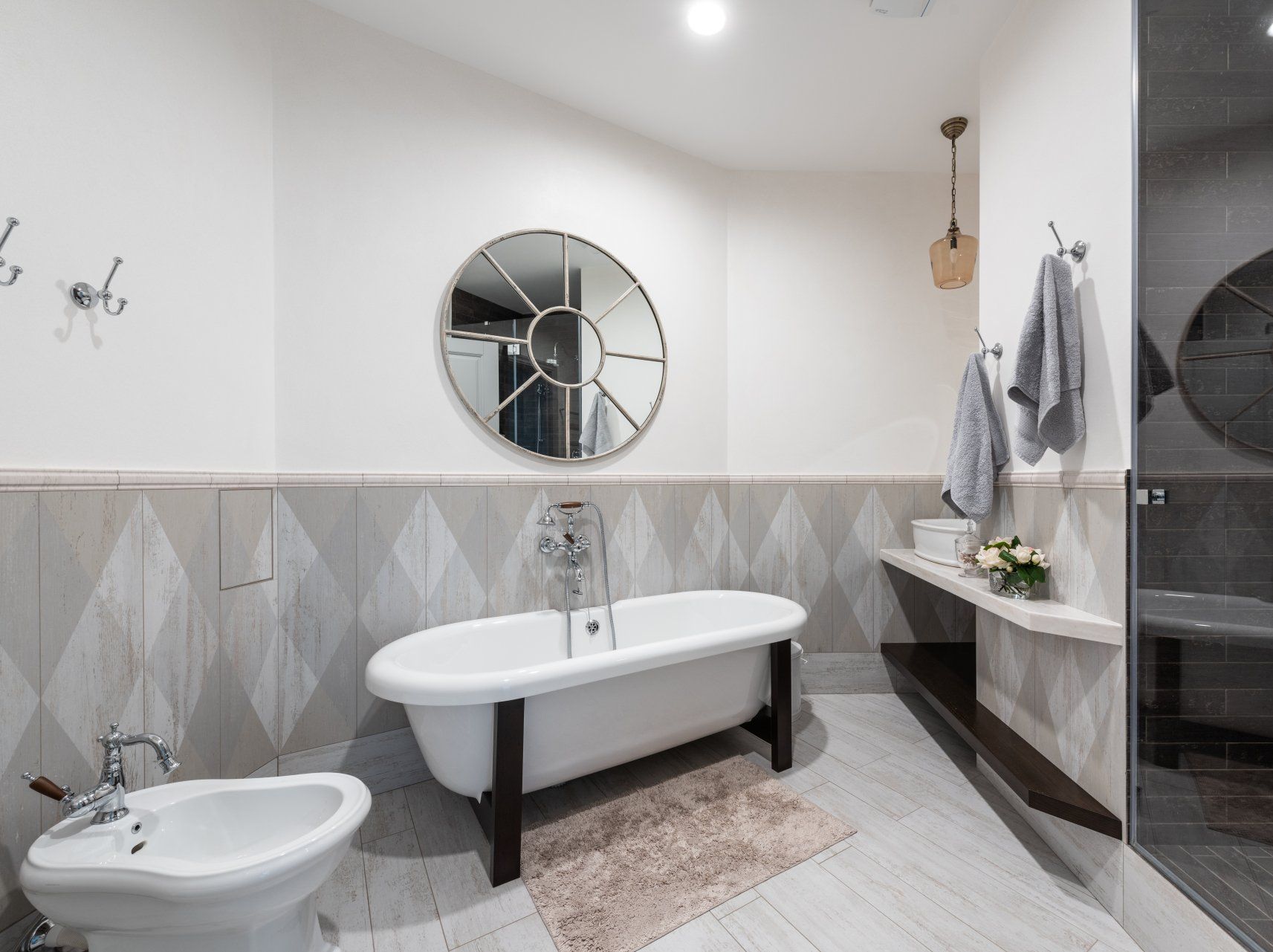
- Bathroom vanities, sized to the room rather than to the nearest stock width. Pairs naturally with our bathroom remodeling work.
- Built-ins for living rooms, hallways and window walls
- Closet systems
that use the full height instead of one rod and one shelf
- Entertainment and media centers built around your equipment and the cable runs
- Bookcases and niches, often built in house because they almost never match a stock size
- Mudroom benches and lockers
If you are running several rooms at once, our
interior remodeling page explains how we sequence the work so the house stays livable.
Our Four-Step Process
We have run this the same way for years because it keeps surprises out of the middle of a project.
Step 1: Initial consultation.
We talk through what you need, what you like and what you want to spend. Your job is to tell us how you actually use the room. Our job is to listen and point you at the choices that fit.
Step 2: Design.
We lay out a plan around your style and your storage, including where the appliances land and how the doors and drawers will clear each other. This is the stage where problems are cheap to fix.
Step 3: Material selection.
Hardwoods, laminates, doors, finishes and hardware, chosen for how they look and how they hold up. We get samples in front of you before anything is ordered.
Step 4: Build, craftsmanship and installation.
Ordered boxes come in, built pieces get made, and our install crew sets everything level and true. We protect floors, run HEPA filtration and clean up daily, so most people stay in the house throughout.
Then we walk it with you. Anything that needs adjusting gets adjusted before we call it finished.
We give free, no-obligation estimates with the numbers laid out up front, and the price we quote is the price you pay. What moves that number:
- How much of the run is built versus ordered. Built pieces cost more per unit. Used surgically, they often save money overall by removing filler and wasted space.
- Door style and finish. Inset doors cost more than overlay, every time, because the tolerances are tighter. Painted finishes cost more than stained in most lines.
- Box construction.
Plywood boxes over particleboard is the upgrade we push hardest, particularly in a bathroom or a laundry.
- Interior hardware. Pull-outs, organizers and soft-close add up quickly across twenty openings.
- Condition of the room.
Walls that are out of plumb, floors that slope, old plaster behind the old run. We find this on demo and we tell you the day we find it.
On timing: most full kitchen or bathroom remodels we run take two to five weeks on site, but cabinetry lead time sits ahead of that. Semi-custom orders have a manufacturing window, and built pieces need shop time. We give you real dates at the design stage rather than a vague range.
If spreading the cost helps, we can connect you with trusted local lenders who offer financing options.
Frequently Asked Questions
What is the difference between semi-custom and fully custom cabinets?
Semi-custom is the middle ground. You get far more choice than stock cabinets in size, style and finish, at a lower cost and a shorter lead time than having every box built from scratch. Fully custom is worth it when a room genuinely demands it, and we will tell you when we think it does.
Can you build a cabinet if nothing in the catalog fits?
Yes. That is the part that sets us apart from a cabinet dealer. We build cabinets in house and also install semi-custom units from a manufacturer. So an odd corner, a run that dies into an angled wall, or a piece that has to work around a chimney chase is not a dealbreaker here.
How long does it take from the first meeting to installation?
It depends on complexity and on lead times, and semi-custom lines are generally quicker than fully custom. You will get a clear timeline at the first consultation, and we update it if anything changes rather than letting you find out on your own.
Can I see samples of materials and finishes before I decide?
Absolutely. We bring samples of the materials, finishes and hardware to you, so you can see and handle the real thing rather than pick from a screen.
Do you only do cabinets, or the whole kitchen?
The whole kitchen. Cabinetry usually runs alongside our kitchen remodeling and countertop installation work, and often flooring too. Doing it as one project means one schedule and one crew rather than three companies pointing at each other.
Do you work outside Port Orchard?
Yes. We are based at 1341 Bay St Ste 130 in Port Orchard and work across Kitsap and Mason County, plus Gig Harbor. See home remodeling near Bremerton for that side of the county.
Is the work guaranteed?
Yes. We stand behind it with a satisfaction guarantee, and we are a local, family-owned and operated, locally owned company. The person who quotes your job is someone you will see again.
Ready to Talk Cabinets?
Bring us a photo, a Pinterest board or a rough sketch on the back of an envelope. We have worked from all three.